
STANDOFFS AND SPACER: WASHERS AND BUSHING
1. Introduction
Standoffs and spacers are two widely used components in FTC mechanisms. They play a critical role in maintaining spacing between metal plates, preventing moving parts from colliding, and creating clearance for components such as gears and motors to operate smoothly.
2. STANDOFFS (THREADED PILLARS)
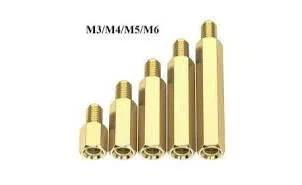
Standoffs are threaded pillars, typically tapped at both ends to accept fasteners. They are used to create a fixed distance between plates while allowing for easy assembly and disassembly.
Key Characteristics of Standoffs:
- Structure: Internally threaded, allowing screws to be driven in from either end.
- Common Materials:
- Brass: High electrical conductivity.
- Stainless Steel: Durable and corrosion-resistant.
- Plastic: Lightweight and non-conductive.
- Nylon: Excellent electrical insulation and vibration dampening.
- Shapes:
- Hexagonal: Easy to grip with a wrench.
- Round: Space-efficient.
2.1. Standoff Classification by Connection Type
Male-Female:
- Features external male threads on one end to screw directly into a plate, and female internal threads on the other to receive a bolt.
- Most common; used in general-purpose assemblies.
Female-Female:
- Features internal female threads on both ends, requiring through-bolts or fastening from both sides.
- Connecting plates from both sides.
Male-Male:
- Features external male threads on both ends, functioning essentially as a threaded stud/coupler.
- Less common; used for specialized mounting interfaces.
3. SPACERS (UNTHREADED BUSHINGS)
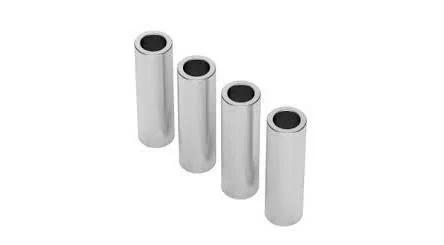
Spacers are unthreaded tubular bushings designed to allow a bolt to pass completely through. Mechanically, this approach is often superior to using standoffs because it allows you to preload the assembly and take advantage of the superior shear and tensile strength of high-strength steel through-bolts.
Advantages of Spacers over Standoffs:
- Superior Load Capacity: Forces are carried directly through the steel bolt rather than the threads of a standoff.
- Better Preload: Enables high clamping torque to firmly compress the plate sandwich together.
- Higher Structural Rigidity: Provides a stiffer assembly that resists loosening under extreme vibration.
- Dimensional Variety: Available in a wide array of standardized lengths and wall thicknesses.
Common Spacer Materials:
- Brass: Electrically conductive and easy to machine.
- Stainless Steel: High strength and corrosion resistance.
- Plastic / Nylon: Lightweight, non-conductive, and low cost.
- Aluminum: Lightweight with excellent structural strength.
4. PLATE AND STANDOFF CONSTRUCTION
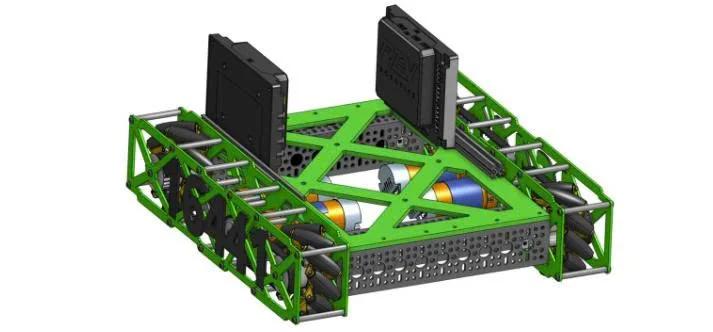
This is one of the most common fabrication and assembly techniques for FTC drivetrains and sub-mechanisms. It is most frequently used in custom gearboxes to support axle bearings and provide a lightweight, rigid structural skeleton.
4.1. Pros and Cons of Plate and Standoff Construction
Assembly and Maintenance
- Advantages: The workflow is intuitive and exceptionally fast, making it ideal for prototyping and onboarding newer team members. Internally mounted components—such as spur gears, sprockets, and motors—are easily serviced or replaced by removing just one outer plate without tearing down the entire robot chassis.
- Disadvantages: Fasteners threaded directly into standoffs are vulnerable to backing out under match vibrations and high-impact collisions, making thread-locking fluid (such as Loctite) mandatory. Additionally, the approach relies on numerous small parts—standoffs, machine screws, and washers—increasing hardware count and the risk of losing fasteners during pit repairs.
Weight and Packaging
- Advantages: Compared to bulky solid billet structures or heavy structural tubing, plate sandwiches yield an extremely high strength-to-weight ratio. They also allow teams to optimize vertical packaging by cleanly stacking multiple mechanism decks within compact dimensional constraints.
- Disadvantages: The flat plates occupy substantial surface area, which can limit open access through the frame. Furthermore, routing sensor cables, motor leads, and CAN lines through tightly spaced parallel plates can become difficult without dedicated wire-pass-through cutouts.
Machining Precision and Motion Quality
- Advantages: When fabricated accurately, plates lock rotating shafts into near-perfect parallelism. This ensures smooth gear mesh, prevents binding under load, and drastically cuts mechanical friction. The flat format also gives designers complete geometric freedom when laying out bearing pockets and motor mounts via CAD.
- Disadvantages: High performance depends directly on machining fidelity. The plates must be manufactured using CNC routers, laser cutters, or precision waterjets; hand-drilling holes or misaligning bearing bores will instantly cause shafts to bind and gears to stall under load.
Structural Rigidity and Load Distribution
- Advantages: When an adequate number of perimeter and center standoffs are used, the twin-plate assembly forms a rigid "torsion box" that evenly distributes dynamic forces across the entire surface area.
- Disadvantages: If standoffs are placed too sparsely or concentrated only in one corner, the entire assembly will flex under rotational torque (torsional twisting). Poor standoff placement leaves the structure prone to deformation, which knocks gear axes out of alignment.
5. TECHNICAL TERMINOLOGY
Preload (Clamping Force): The internal tension developed in a bolt when tightened, which generates a clamping force holding the mating plates tightly together. A proper preload significantly improves resistance to dynamic shock, shear loads, and vibration loosening compared to rely-on-thread standoff configurations. Preload is vital for dynamic robot loads like FTC drivetrains.
Torsion (Torsional Twist): The twisting or angular deformation of an object when subjected to a torque. In plate-and-standoff construction, if standoffs are sparse or poorly placed around shafts and outer perimeters, the entire gearbox or chassis will twist under drivetrain torque, leading to gear misalignment and catastrophic binding.