
BELT DRIVE SYSTEMS
Timing Belts
Belts are typically used to transmit light-to-moderate torque loads. While they can still be utilized in high-load applications such as drivetrains, belts capable of handling loads comparable to chains are usually much wider than chains.
Similar to chains, there are various types of timing belts; the most common types in FTC are 3mm GT2, 2mm GT2, 5mm HTD, and 3mm HTD.
1. COMMON BELT TYPES IN FTC
3mm GT2
- Description: Features a 3mm pitch. Uses a curved PowerGrip tooth profile.
- Characteristics: A "must-have" for almost any FTC robot. It strikes a perfect balance between compact size and load-bearing capacity.
- Advantages: Extremely low backlash, highly resistant to tooth jumping (slipping) when properly tensioned.
2mm GT2
- Description: Features a tight 2mm pitch; the teeth and belt are very thin and delicate.
- Characteristics: Used for ultra-lightweight mechanisms where space is the top priority.
- Advantages: Extremely lightweight, runs smoothly at high speeds.
- Disadvantages: Highly prone to tooth jumping under heavy loads.
S3M / 3mm HTD
- Description: Features a 3mm pitch but uses an older rounded-tooth profile (HTD - High Torque Drive).
- Characteristics: Often found on industrial components (such as Misumi parts) or custom team-machined pulleys.
- Advantages: Very durable in rugged transmission applications.
- Disadvantages: Slightly higher backlash compared to GT2, making it less preferred for arms requiring absolute positioning precision.
5mm HTD
- Description: Features a 5mm pitch with the characteristic deep, rounded teeth of the HTD system.
- Characteristics: The "powerhouse" of robot belts. Commonly used in drivetrains or heavy-duty lifting mechanisms.
- Advantages: Capable of handling massive torque loads. Nearly immune to tooth jumping thanks to its large, deep teeth. Extremely durable under heavy stress.
- Disadvantages: Pulleys and belts are very large and bulky, taking up significant space. Notable backlash makes it unsuitable for mechanisms requiring absolute positional accuracy.
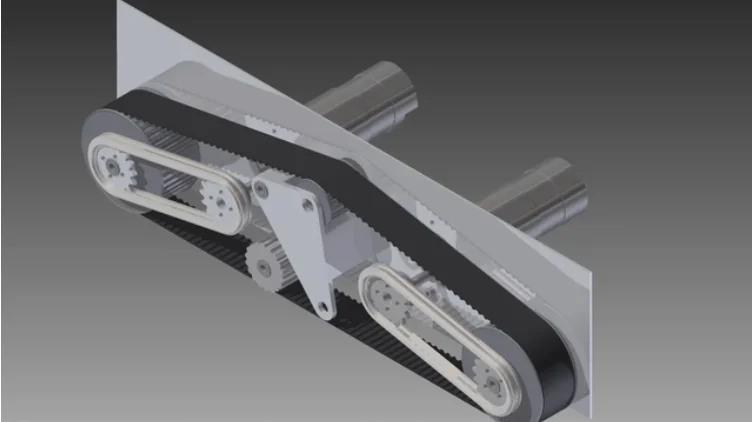
2. PULLEY AND BELT DESIGN
Similar to chains, belt drives require precise center-to-center distances to achieve proper tension for efficient transmission while preventing slip and energy loss. However, belts come in fixed standard lengths.
To calculate the center distance for a specific belt length, or to determine the required belt length for a fixed center distance, you can use the following tool:
Belt Size Calculator (everycalc)
Manual Calculation via Pitch Length
Another way to design a belt drive is by using the pitch length. To calculate the pitch length of a belt, multiply the pitch by the number of teeth:
Pitch Length=Pitch×Number of Teeth\text{Pitch Length} = \text{Pitch} \times \text{Number of Teeth}Pitch Length=Pitch×Number of Teeth
The belt you use must match pulleys with a known pitch diameter:
Pitch Diameter=Pitch×Number of Teethπ\text{Pitch Diameter} = \frac{\text{Pitch} \times \text{Number of Teeth}}{\pi}Pitch Diameter=πPitch×Number of Teeth
Typically, you can look up pulley pitch diameters directly on the vendor's website.
For a simple belt run between two pulleys, you can sketch the layout by drawing both pulleys at their pitch diameters and connecting them with tangent lines. You can then size the path length to match the pitch length of the belt.
Important Note
Keep in mind that after extended use, timing belts can stretch and lose their initial tension, which can impact the performance of the mechanism.